Friday, 8 June 2018

30 Days Wild - Ranworth Magic

8th June - NWT Ranworth Broad

Of all the bird species that inhabit or visit Norfolk Wildlife Trust’s reserve at Ranworth Broad, three are of particular consequence: great crested Grebe, swallow and common tern. None of these species are rare of endangered, all can be found in many other places, but in my opinion the trio combined serve to make the site what it is. Why is this so? The answer I think lies in the fact that all are showy birds, all are seen at their most colourful and loudest during summer when the reserve itself is at its best and thronged with holidaymakers. Additionally the day to day antics of the swallows and terns can be viewed on screens positioned in the Visitor Centre allowing intimate access into their lives, thus ensuring they find a place in people’s hearts. There is no camera trained on the grebes but their courtship rituals and resulting humbug decorated chicks can be viewed at close quarters every year and provide great entertainment for those who watch them. Sadly this year has thrown challenges at these icons and their fortunes have wavered accordingly. 


The grebes seem to have had a difficult year to date in terms of breeding attempts. There are, I judge, around ten pairs around the broad allowing in a good year up to three nests, flimsy floating piles of flotsam, to be positioned on the small promontory opposite the Visitor Centre. This season a single pair has attempted, twice, to construct a nest but has been thwarted by a combination of very high water levels flooding their potential home together with the unwelcome attention of black-headed gulls. These pirates have an annoying habit of stealing sticks and reed stems for their own nests, and simply won’t let the grebes settle. To date no grebe nests bedeck this area. On the other side of the broad a pair was on eggs during April and early May, but has failed to hatch young. They are currently going for a second attempt. Collectively the persistence of the local population will produce results, but maybe in smaller numbers than usual.

Swallows are in short supply. They arrived very late and at present only a single pair seems to be actively engaged in a breeding attempt. This is a shame, not just for the birds fortunes, but because it is not possible to train a camera on this nest. Children adore watching the adults feed the chicks live and close up; sadly it doesn’t look like any such show will be possible. Seeing the adults and their offspring flying around the building in late summer, twittering to themselves is something that epitomises Ranworth for me. The visible product of a successful summer of industry; whether any such gatherings will take place during 2018 remains to be seen.
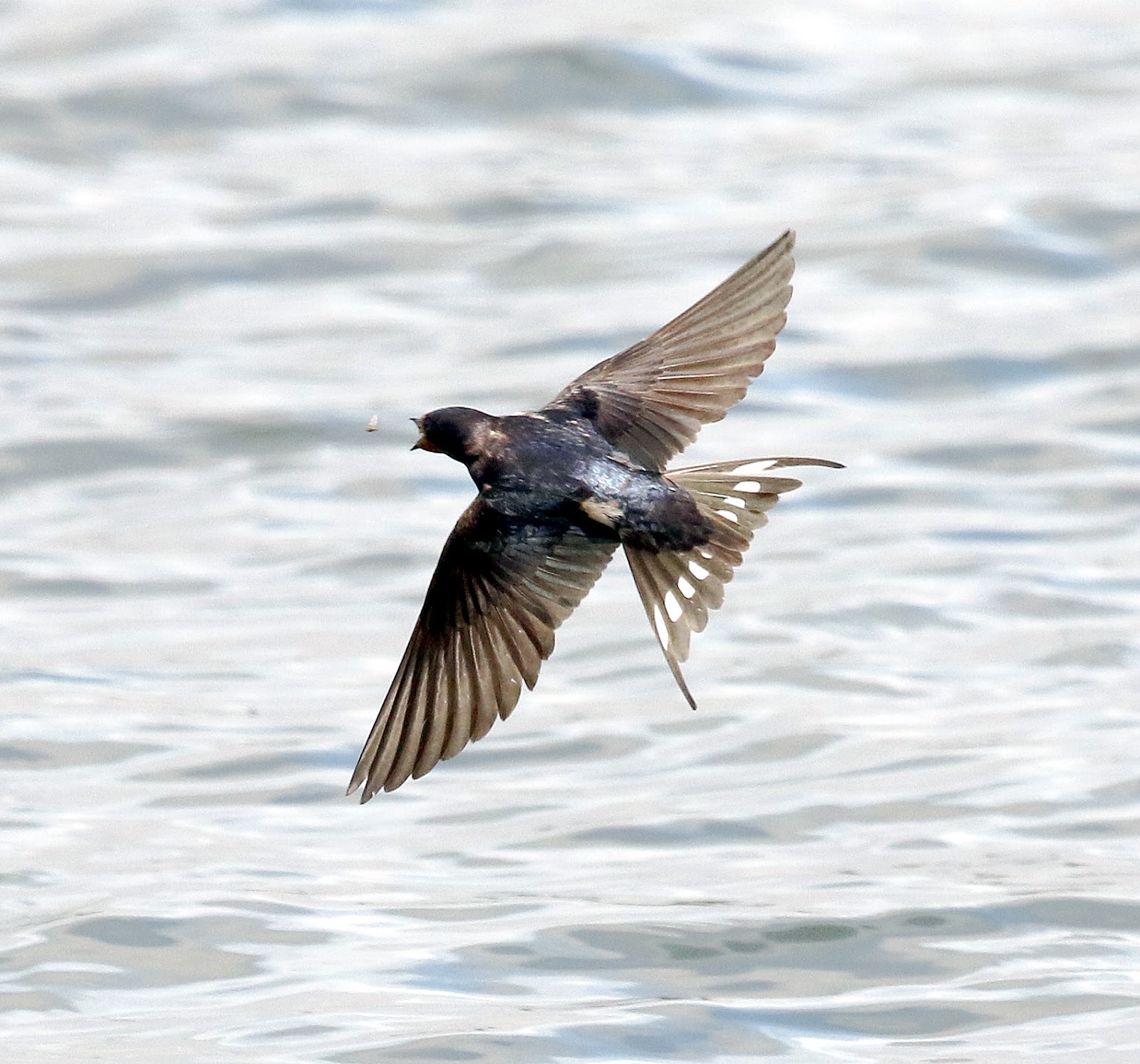

The terns only arrived in numbers during late April and early May. By this time the gulls (again) had settled on the nesting rafts making it difficult for the daintier, less robust terns to move in. However once numbers reach a certain critical mass they do set up their nests and there are currently some 50 or so pairs in residence. Watching these graceful fishermen floating on sharply pointed wings through the warn air of a June day is uplifting. Things will hot up once hungry chicks are waiting to be fed when the parents will create an aerial skyway directly to Malthouse Broad where they will find plenty of small fry. There will be a constant procession of screeching terns to and fro until the mottled young fledge in late summer.


Today just before the end of my shift the collective force of terns and gulls launched as one into the air. At first no predator was obvious but then the head of an otter appeared from behind one of the platforms. The otters cannot access the platforms; the overhanging design prevents this, so this frustrated aquatic predator swam away with a succession of angry birds aiming their sharp beaks at its crown. It came close to my position on the boardwalk from where I watched it fishing in relative tranquility for 10 minutes before it swam away along the cut to chance its arm elsewhere, scattering anxious mallard mothers as it progressed.


There’s always something interesting to see here, and the three bird species provide constant entertainment and enlightenment. Long may it remain so.


Thursday, 7 June 2018

30 Days Wild - Barn Owl Country

7th June 2018 - South Norfolk

Barn owls are among my favourite birds. I love the way they look, the way they fly and the fact you can go out searching for them in certain places at dusk and after dark with a reasonable degree of expectation. If you know where to look. Despite the harsh winter snows and the weird, cold, damp spring they seem to be doing well here in Norfolk. Perhaps the vole cycle here is at a peak which will assist them with their breeding attempts. In the Claylands area south of Norwich you will find rolling countryside rich in wild flowers, damp meadow in the river valleys, ancient commons and their associated gnarled old trees. Perfect habitat for these birds of prey that are very popular with landowners and the local inhabitants. A pair has a nest in a barn at the end of a farm track not far from a friend’s house. By parking off-road in the gateway area it is possible to watch the birds hunting over the surrounding fields, sometimes within a few metres of the pretty rustic cottages aligning these quiet country lanes. There are at least four pairs we know of locally, but this one is the most accessible and if you keep still and use fence posts or your car as cover they will ignore you and come close.

A few weeks ago in the early evening I huddled alone behind the gatepost and within a few minutes saw one of the parents hop out of the barn and onto the adjoining wall. It preened for a little while and then took wing, flying directly towards me. I was at least 200 metres from the nest site so as to avoid any possibility of spooking the breeding birds, but watched this beautiful creature bounce its way along the farm track getting closer all the time. It was only when it reached the gate that it saw me, jinked to one side and flew slowly past looking directly at me with those wide dark eyes. I’m not sure who was more surprised. 


The bird didn’t seem too worried about this encounter and proceeded to hunt on the daisy strewn road island directly behind me. After a while my friend arrived and we watched the pair periodically hunting at distance around the local fields whilst being more closely entertained by swallows hurtling to their nests built below road level under a bridge spanning a ditch, a singing lesser whitethroat and a passing little egret.

After a spell my mate noticed one of the owls diving down into a field edge some 100 metres away to our right. We watched and after a while the bird took wing with something large dangling from its talons. ‘My god!’ I exclaimed ‘I think it’s caught a pheasant’. Now this would have been an extraordinary, nay unique, circumstance had it have been correct, but through raised binoculars it became clear that the red and brown object in tow was a kestrel, alive and very much kicking. Kleptoparasitism has become a common phenomenon between barn owls and kestrels but I never thought to witness such an event first hand. A frenzy of fevered photography ensued trying to capture the outcome of this mammoth tussle. Both birds had their talons firmly clasped on a vole, the kestrel tugging with all its might to steal the prize; the owl clinging on for dear life. Looking through the image afterwards it appears the owl was making life very difficult for the falcon by sometimes grasping a wing in one talon and giving it a twist. Whatever, the kestrel eventually gave up, leaving the owl to continue its journey unmolested back to the nest. Boy, that was good!


Tonight, the owls failed to show, it was probably too early for them. Instead attention was diverted to the margins of the fields all around where sympathetic and wildlife conscious farming has created a broad swathe of wild flowers. Bees were everywhere buzzing around the blooms of vetch, poppy and cornflower; so prolific were they here that their collective humming was clearly audible. And these selfsame bees will serve the farmer well by helping pollinate his own crops - that’s all it takes, just a tiny bit of positive thought and caring. Top man!


Wednesday, 6 June 2018

30 days Wild - In Search of Swallowtails

6th June - RSPB Strumpshaw Fen, Norfolk


The day, as every one for the last week, dawned grey and misty here in Norfolk, the airflow from the east or north ensuring cool breezes and sea frets aplenty. It didn’t bode well for a shift at RSPB Strumpshaw Fen providing people with information about swallowtails: it was unlikely there would be any around. I went anyway relying on the weather forecast to be right for once: getting warmer during the afternoon thus hopefully encouraging these gorgeous insects to take flight and seek nectar.

Newly Fledged Blue Tit 


But first a slow walk around the reserve to see what other creatures I could find sheltering from the breeze and the gloom. I don’t think I’ve ever seen so much life! It seemed every bush, every stand of nettles, every clump of reeds held a menagerie of small animals. Predator and prey, mate and rival, some flaunting their presence, others simply wanted to remain undisturbed and hidden. My camera went into overdrive. There were flies of all kinds, spiders, damselflies, beetles, wasps, bees and ladybirds. I saw resting moths, butterflies and a dragonfly, watched sparring buzzards, marsh harriers displaying, heard a bitten booming and a pair of garden warblers singing in rivalry. I found lizards seeking warmth, a cuckoo seeking a mate and a few people seeking that elusive large butterfly. They wouldn’t fly in the cool and windy weather, but I did find a single egg on a milk parsley plant - proof that they have been around recently.

Bombus pratorum (left) and Bombus pascuorum - I think!

Pregnant Common Lizard

Common Stretch Spider (Tetragnatha extensa) With Prey

Longhorn Moth (Nemophora degeerella)

Cardinal Beetle (Phrochroa serraticornis)

Common Carpet

Scarce Chaser (female)

Unknown Spider sps - I'll find out!

Female Banded Demoiselle

Snout

Swallowtail Egg on Milk Parsley
Then the sun burst through the cloud. Transformation. Everything turned technicolour and it felt like June at last. I timed my arrival back at reception to perfection. No sooner had I set up the welcome stand than a beautiful insect that is a swallowtail butterfly descended onto the Dame’s violet flowers, nectar rich, planted especially for these showy insects to enjoy. What a joy to see these impressive butterflies once again. It seems there is a reasonable population this year and adding up reports from various parts of the reserve would indicate a minimum of ten seen today. That doesn’t sound many, but this is a rare species in the U.K. with its only stronghold the Norfolk Broads - we are so lucky here. Their flight season is so short too, so there is always something of a frenzy to see them. Visitor numbers increased as the afternoon wore on and all were able to see a swallowtail at very close quarters and went away satisfied. Weather forecasters I salute you.

Yours Truly, Ready to Serve!

The Beautiful Swallowtail

Tuesday, 5 June 2018

30 Days Wild - Reptile Hunt


5th June - How Hill, Norfolk

Young Grass Snake
As a young man I read books by such pioneering photographers and naturalists as Eric Hosking, Ted Ellis and Arthur Patterson. All spent much time in the Norfolk Broads at mystical places such as Hickling and Wheatfen where they could discover hidden places full of wonderful wildlife: bitterns, harriers, bearded tits, raft spiders and the like. I had then no means of reaching such locations, and even if I could there was no way I would have been allowed to tramp over sensitive private reserves. That privilege was granted to a chosen few: not to oiks like me.

Scroll forward forty years and things have changed. I found myself this evening wading through waterlogged reed beds and flower strewn meadows quite legitimately. Here I am in the middle of the very landscape I love with a passion, taking the easy route by following a beaten trail blazed by a deer through the lush wetland growth- the only sign of recent access - to investigate what may be sheltering under mats we had set out a few weeks ago to attract reptiles. All this courtesy of volunteering for the Broads Authority. I felt blessed.


The reason for our surveys is to develop a picture of the reptiles using the site (other surveys will look for bitterns, water voles and marsh plants) so that should any management work be proposed or outside development threatened there will be an informed view of what species are using the site and their relative population density. In this way proper consideration can be given to how such work should proceed (if at all) and appropriate mitigation measures put in place. That’s got to be worth doing I feel.


How Hill
We have four compartments to survey my colleague and me, two at Buttle Marsh and the other pair half a mile away at How Hill. We trudge in wellies and fleeces, protection against what is a chilly evening, to the first pair of compartments at Buttle one of which on previous visits was simply too waterlogged to consider entering. Tonight it seems a bit dryer, but this is hard to judge because what was almost bare ground in April is now transformed into an emergent reed bed reaching to chest height. We risk it and are immediately rewarded with a small grass snake that has sought shelter under the first of the strategically positioned mats of corrugated composite. We find a couple of common lizards under other mats, but no other reptiles. But this doesn’t matter because the anticipation of lifting the mats to see what lurks underneath is exhilarating. And despite the absence of reptiles, there are other things to find seeking shelter and warmth there; spiders, ants, caterpillars and once a lovely vole’s nest. Just being here is a great pleasure; to know we are possibly two of a very small number of people who will have the privilege to set foot on this marsh this year is something hard to put into words. There are few true wildernesses left in the U.K today, yet although this landscape is intensively managed, can be viewed from public footpaths and is quite small, in its own way it is as remote as the highest peak, the deepest glen, the thickest forest; for who would venture here on a whim? Trudging through the mire, every step splashing and wellies sucked into the gluttonous mud. This is what I was made for.

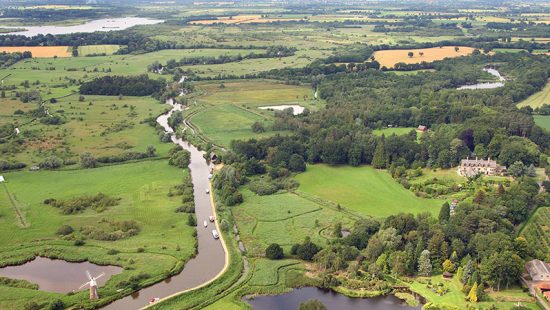
Aerial View of How Hill - Compartments are just above the centre point to the right of the river. 

We see other things; a bittern glides across the fen, probably a female on a feeding flight to or from its nest, a grasshopper warbler reels away from the depths, bright blue damselflies bounce from stem to stem as we disturb their rest and myriad tiny moths scatter as we pass. We find caterpillars of drinker moths and garden tiger, discover scat of fox and deer. This place is home to so much life and we’ve only been surveying for 40 minutes.

Vole Nest

Garden Tiger Larvae - The Woolly Bear 

Common Lizard

Red Ants - Myrmica rubra
We walk back along the towpath passing holidaymakers moored on the banks of the Ant, cooking sausages and burgers on small barbecues and sipping wine. We nod, smile and quip to a few before heading out to the meadows comprising the second of our duo of compartments. The adjacent fields here are quite different from those at Buttle. Here the reed growth is confined to the margins, the central portions being more open as a result of annual grazing by a herd of ponies. This doesn’t mean progress is any easier for the prolific growth of thigh high sedge hampers smooth movement. Despite the meadows being quite waterlogged we do find a couple more small grass snakes and a few common lizards, one of which is obviously a pregnant female. A cuckoo calls......

Monday, 4 June 2018

30 Days Wild - Norwich Peregrines

4th June 2018 - Norwich Cathedral Peregrines


There is a pair of peregrines nesting on Norwich cathedral; they occupy a platform positioned by the Hawk & Owl Trust half way up the eastward facing section of the spire. This platform has been used as a nest site for the last seven years with a good deal of fledging success during that time. There is a live web feed from a camera positioned just above the nest which generates a huge amount of interest from the general public who can watch the antics of the birds 24 hours a day. And it really is something of a soap opera. Two years ago a big, aggressive female arrived on the scene, ousted the resident female (who was never seen or heard of again) and took over the territory. The resident male, as men do, took an instant fancy to this young bird and started flirting with her quite unashamedly. There were great fears that in the throes of new found love he would neglect his young offspring, but to his great credit he managed to provide for them and raised them single handedly. The new female, referred to ever since as GA because of the code on her leg ring attached to her in Bath, had nothing whatsoever to do with the chicks because they were not hers. All was good until the chicks fledged and left the nest whereupon GA attacked them one by one and sadly caused their demise. Last year the new pair had a full clutch of four eggs, but one or two mishaps resulted in only a single chick fledging. That’s ok; peregrines are long lived birds and top predators, so fledging one or two chicks a year is success enough. This year with greater experience, 3 of the 4 eggs hatched and the resulting chicks are currently robust, healthy and on course to fledge sometime towards the middle of this month.

I volunteer my services at the H&O watch point in the cathedral close on a Monday afternoon and this allows a great insight into the lives of these majestic Falcons. The setup is very slick nowadays with several telescopes trained on the action for the public to use and see nature red in tooth and claw. (There really is nothing like seeing in close up the entrails of a disemboweled pigeon sliding down the cathedral spire to make you realise nature can, and often is, quite brutal). Volunteers like me point things out and tell people about the birds and their habits. It really is heartening how folk of all ages and from all walks of life engage with these raptors and are fascinated by their lives.


Anyway today, although quiet in terms of numbers, did illustrate the effect seeing such dynamic wild creatures in the flesh can have. I heard more than one ‘wow!’, ‘amazing!’, and various other utterances requiring exclamation marks. All these an involuntary reaction to being able to see a beautiful adult peregrine falcon simply sitting on one of the cathedral crockets. With the chicks now well grown and fed, the adult birds had relatively little to do. There was one food pass however, resulting in what was, for me, the sweetest moment of the day. GA having taken her fill allowed the male to take what was left of the pigeon carcass for his own. He disappeared behind the spire from where a paper chase of downy feathers could be seen scattering in the quite chilly northerly breeze. Within a couple of minutes a group of swifts appeared circling around the spire. Initially I wondered if these were simply mobbing the falcons but then realised they were catching the feathers in midair to use for their nests. That pigeon was well and truly recycled.

Sometimes one or other of the birds can disappear for some time. On my last shift GA was absent for three hours and upon her return her mate flew off and hadn’t reappeared by the time the shift was over. On the off chance that something good may happen given the long period without prey being brought to the nest site, I chanced a few minutes wait in the cathedral cloisters from where you are much closer to the action. My hunch paid off within a few minutes when the male brought a complete feral pigeon carcass to the female. She accepted the prize and proceeded to circle the spire calling loudly, dead pigeon dangling from her talons. Its moments like these that make long uneventful waits and the whole volunteering effort so worthwhile.