Sunday, 13 November 2016

Pygmies and Giants

It glared at us from baleful lemon yellow eyes, sat atop a tangle of fallen branches and roots. A ferruginous Pygmy owl, one of a pair our guide had picked up calling from the track along which we had been strolling. The ability of this knowledgable lady to filter out from the cacophony of frog croaks and birdsong an isolated call of a target bird is uncanny, but luckily for us unfailing. We watched this diminutive owl for a couple of minutes until it decided it had provided enough entertainment and flew across the road and disappeared into some bushes.


It was so good to be able at last to venture out from the lodge because finally, thankfully, the rain had eased in mid afternoon allowing us to walk along the puddle strewn road. Butterflies, dragonflies and insects of all kinds, especially mosquitoes, revelled in the cocktail of 95% humidity and a never ending supply of still water in which to set about their breeding cycle. The hungry female mosquitoes certainly found a good food source in this particular lily-skinned Brit. Sweet blood for all.

Our guide, making up for lost time, was most keen to show us as many of the special species of the area as was humanly possible in the couple of hours available. First up a helmeted manikin that frantically responded to a recording of one of its kind, hopping around tantalisingly from branch to branch in the forest of dense scrub. What a stunning bird, jet black body capped by a shock of scarlet on the crown and nape. Quite lovely.


The great potoo we saw from the safari wagon yesterday had chosen to roost in the same spot and didn't flinch as we gathered round it's chosen tree to crane our necks for a second look. What a strange looking bird, although its camouflage is truly extraordinary. Seen from any angle it simply looked like an extension of the dead bough on which it perched motionless throughout the sodden wet of the day. 


And this brought us via various woodpeckers, lapwings, cowbirds and flycatchers to the aforementioned pygmy owl, after whose acquaintance we traversed a rough meadow to enter a grove of tall palm trees. More pesky mosquitoes. But these things must be brushed aside for we had come here for another owl, a much larger great horned owl, which before long was being admired through binoculars and providing frame filling images for us to post on Facebook or maybe into a blog. What a contrast to the little chap we had seen earlier. This bird was big and impressive with large brown eyes set in a facial disk ringed with black feathering. Ear tufts raised, the bird looked impassively down at us, quite unperturbed by our presence. It twisted its large head to and fro a couple of times, yawned in a leisurely way before launching itself on silent, rounded wings to twist and turn between the trees to another unmolested roosting spot. 


All that excitement took place yesterday, the late afternoon of Saturday 12th. Today with fears of another soaking clouding our minds we once again took to the water in search of acquatic wildlife. It did rain, light misty showers refreshed our sweaty faces from time to time, but happily the experiences of two days ago were not repeated. Instead we were treated to the impressive sight of a family party of giant otters that we tracked as they swam powerfully across the lake. These creatures were inquisitive to a degree, thrusting their heads out of the murky, mud churned water to have a good look at us, but had some small cubs in tow so were unwilling to expose them to potential danger. Once they reached the far bank they were gone in an instant.


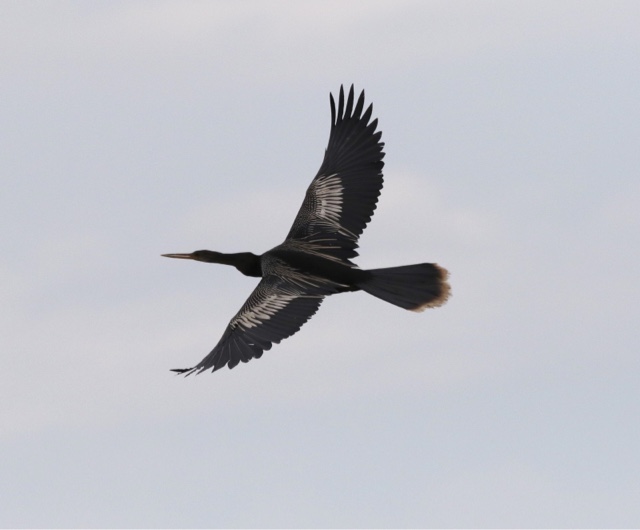
We reached a shallow lagoon where predators had gathered to feast on the huge numbers of fish using the river system to spawn. Around this small area we espied lots of caiman, large yellow-billed terns, anhingas, black collared Hawks, herons and kingfishers all waiting to cash in on the hordes. Who'd be a fish? We witnessed a strange phenomenon as we motored along with fish jumping out of the water all around us. Two actually landed in the boat much to the surprise and delight of all. No teeth to worry about on these river inhabitants so they were picked up and returned to their homes.


Then it was time to chill, write up this blog, listen to the birds, frogs and cicadas and watch the butterflies float around the grounds. There may have been a beer or two involved as well.


Saturday, 12 November 2016

Early Rains

Saturday 12th November.

It is raining. As I sit here typing this post I am looking at a bedraggled woodpecker clinging to the underside of a stout bough, there to shelter from the deluge. The poor thing is clinging motionless at 45 degrees with its stiff tail feathers bracing it for what looks like being a lengthy stay. A few moments ago a greater kiskadee briefly perched on the back of an adjacent chair, called loudly, indignantly, at the thundering rain and flew off to find its own place to hole up for a spell. It is coming down hard and has been since just after dawn. At 5.30 as the first tendrils of daylight fanned through the trees, the air was fresh from the previous night's downpour; some promise of a drier day ahead. By 6.00 the first few spots of liquid dripped from a gloomy sky and before long cascades of water were flowing along the paths and forming puddles in the already sodden ground. The rains that normally arrive in December have decided to come early this year.

Yesterday, Friday, was a day of contrasts, a game of two halves as they often expound on Match of the Day. During the oppressively hot, steamy morning we boarded an open sided vehicle to bump and grind our way along sandy tracks through the Pantanal Savannah. Bird life was prolific here with frequent stops to appreciate the various species that are now into their breeding season; some singing, some tussling with rivals, some building nests or feeding young. The rains bring life to the parched land that bakes during the dry season; the wildlife takes advantage of the bounty following in its wake. We paused to discover that the broken branch of a tree being pointed to by our guide was in fact a great potoo roosting for the day, watch a roadside hawk fastidiously preening itself, admire a family party of burrowing owls sunning themselves from fence posts bordering the track, marvel at a pair of red-legged seriema strutting on ridiculously long legs through the dry brush. And all the while the dark shapes of vultures cruised the warm air above.


Virtually every bird seen here is new to us, but there was one that I have personally wanted to see in the wild for a long time. And our expert guide knew exactly where to look. Can there be any finer colouration on any bird than that adorning a hyacinth Macaw? I think not. We found a small flock feeding in a palm, a little skittish at our approach. They decided soon enough to find a more secluded feeding spot and one by one launched into the air to delight us as they glided past, their velvet, electric blue, feathering shown to perfection in the strong morning sunlight. Only nature can produce such finery; subtle tones and shades on a theme that no artist can match. The reason the birds are suffering here, as many birds and animals are suffering all over the globe, is thanks to the activity of man. The small coconut palms bearing fruits of specific attraction to the birds are grubbed up to make way for crops and grass with which to feed the cattle that roam here in numbers. The macaws are forced out. Happily the lodge where we are ensconced for a few days is engaging with the local farmers to educate them to the needs of the birds while also pointing out the benefits their presence brings in terms of Eco tourism. A classic win-win, which in this case means the macaws have an ample supply of nuts upon which to weald their tremendously strong beak and the lodge supplements the farmsteads with food. Such gorgeous creatures and a serious tick for me. Happy smiles all around.


The afternoon was given over to a trip along the river Mutum in a motorised canoe, slowly examining the riverbanks for whatever birds and mammals felt like showing themselves. Of course the showy kingfishers are the main stars, sitting ever watchful on overhanging branches scrutinising the clear waters with bright beady eyes. I blogged a few months ago about my rather over ambitious thoughts of seeing all the worlds kingfishers, bee eaters and rollers. Whilst I stand little chance of fulfilling this aim, it is nonetheless quite possible to see all five of the South American kingfishers on this trip. In fact having seen three species in Ecuador I only need green and Pygmy kingfishers to complete the list. The quest was on. So, for the next couple of hours eyes and ears were strained in an attempt to locate these small and obviously elusive gems. We saw several brazen Amazon kingfishers and lots of ringed kingfishers, but nothing new. That is until it began to rain when a small green bird shot across the river in front of us and disappeared into the overhang. 'Green kingfisher' came the cry from our guide and with that another minor, to many insignificant, to me immensely satisfying, goal was reached. Only one more to go, but sadly this is where the adventure ended, at least for that day. The heavens opened and then some. All in the canoe frantically pulled on the plastic ponchos provided, covered cameras, binoculars and other things of value with any waterproofs to hand, gritted teeth and braved the angry elements. Despite worrying about my optics, I actually enjoyed the feeling of fresh cool rain on my face. Zipping around, blasting into heavy squalls with curtains of water lashing all around was quite exhilarating. It was only later I discovered a sodden wallet full of damp and soggy bank notes which took the shine off the experience a little. 


And so we come to today. It is now early afternoon and the rain is still falling. Toads and frogs are having a ball, Muscovy ducks have paid a visit and ibis probe the wet earth with long decurved beaks. There is talk of a walk around the site a bit later, but I'm going to crack open a beer and relax. I'm no weather forecaster but it really doesn't look like we're going anywhere, anytime soon. There's always tomorrow.

Friday, 11 November 2016

A Touch of Brazilian Magic

We arrived to the ominous sound of rumbling thunder issued from the depths of evil looking clouds that every so often would spit jagged forks of lightning. The accompanying humidity made for an uncomfortable welcome to our stay in the southern Pantanal. But the rain didn't materialise, at least no more than a few drops helping to refresh our tired and unwashed selves. We had been travelling for 30 hours with the last three of them over rough roads that meandered through small townships and at last gave way to a sandy track cut through the open savannah where termite mounds dotted the fields like so many gravestones.


We were given little time to rest by our guide who was keen to maximise the time she has with us; four weary Europeans that for the next little while find themselves guests of people who dwell in a remote Brazilian land that for 7 months of the year in under water. This first stop is at Pousada Rio Mutum, a lodge placed on the banks of the river from which it borrows it's name. The open grounds play host to an array of exotic looking birds, chief among them being the cantankerous, loud, ever watchful rusty-margined guan that vie with the high strutting bare-faced curassow, buff-necked ibis and thrushes for the pleasure of feasting on ripe mangoes that drop without warning from heavily laden trees. 


The fruits that still hang in tempting clusters are ravished by an array of other birds, parrots, McCaws, Orioles, tanagers and jays. Greater kiskadees eye their territory from convenient perches ready to pounce on any passing insect or small lizard. We watched a pair hunt frogs at the water's edge whacking the poor amphibian mercilessly against a branch in the manner of a kingfisher. In a tree by the water's edge a pair of black collared hawks were busy courting as oblivious to the osprey perched nearby as it was to them. There is so much here that it is hard not to be overwhelmed; I am already like a child in a particularly sumptuous sweet shop.


So, our guide invited us to step into a canoe and gently paddled us around clear, calm waters for an hour or so. Here were kingfishers: ringed - bold and showy;  green and rufous - smaller and more evenly proportioned; and the Amazon - dagger billed and impervious to our close scrutiny. Other birds dotted the riverside vegetation; neotropic cormorants, anhingas, jacanas and herons. A pair of southern screamers lived up to their names screeching their almightilly loud, raucous cries across the still air of the gathering dusk. And then somehow from great distance our guide thought she had caught a glimpse of a capybara. We strained our eyes but could see nothing but acres of water plants and dense vegetation until as we edged closer and closer, the bulky shape of a small group of these weird animals could be seen sitting stock still on the shoreline. How big are they! I've seen these things many times on TV but was not prepared for the reality of seeing close to these pig sized aquatic animals. Most impressive. 


We retired early, completely worn out but looking forward to whatever delights the following 3 days here will bring. We are promised an action packed agenda. Watch this space.

Sunday, 21 August 2016

Here There Be Dragons


Away from the brisk westerly breeze sweeping across the swaying mops of fading pink hemp agrimony, apart from the rustling of thousands of swaying reed stems, we found a sheltered spot in the lee of gnarled and twisted birch. Here was the domain of the dragonfly. Atop every dead stem a common darter perched, its multi-faceted eyes scanning the area around its chosen observation point for potential prey or a mate. We watched these four winged predators as they sparred, hunted and courted, arrowing through the warm August air on their short-lived mission to foster another generation. We were quite mesmerised by these jewels of the insect world; wings glistening, backlit against the burning sun of high summer. With the aid of binoculars every minute hair on the dragonflies legs could be seen, every vein on the paper thin wings, every hexagonal lens of their bulbous, rich brown compound eye. The challenge of course was to photograph these sparkling miracles of nature and do justice to their form; an impossible task really, but we felt compelled to try and capture something of their ethereal beauty and record the moment.


The venue for this spell of insect photography was the wonderful Norfolk Wildlife Trust reserve at Hickling Broad. I can remember the first time I espied this rather special place. On that occasion it was from the high ground near Martham on a pristine June day the best part of half a century ago.

Me and my young friends had spent the day aimlessly cycling along country lanes with no particular destination in mind and here we were taking a breather whilst overlooking the famous Broadland haven. Eric Hosking was to blame for us having knowledge of this place; his autobiographical work ’An Eye for a Bird’ had enthralled us and filled our young minds with visions of exotic places and even more exotic birds. But the most interesting aspect of the book (borrowed regularly from the local library) was the whole chapter devoted to Hickling, a place held dear to his heart and one this pioneering photographer visited regularly during the war years. Within this chapter were accounts of intimately close encounters with bitterns, bearded tits, harriers, both marsh and Montagu’s, as well as anecdotes concerning other species we had hardly heard of let alone dreamed of seeing. But it was getting late, the sun slowly lowering into the western sky and we had 20 miles to cycle home. The reserve was tantalisingly close but its exploration would have to wait for another day.

As it happened that day was many years in the future; the 1980s in fact when I began to visit the area regularly to watch the harriers and cranes coming in to roost at Stubb Mill, then simply a raised muddy bank, exposed and lonely. And it wasn't until I started working for NWT much later still that I got to know the reserve better. Of course much has changed since the days of Hosking. NWT now manages a vast area of this unique landscape allowing public access to much of it year round. Summer boat trips take eager eyed visitors to secret niches where otters, spoonbills, waders and purple hairstreaks can be seen, whilst the Visitor Centre ensures a warm welcome. But the essential wildness remains; acres of reed interspersed with shallow creeks where the billowing sails of river craft glide sedately past. Wide open skies punctured by silhouettes of wind pumps and stands of wet woodland. Broadland at its most evocative.


For all that, it can sometimes seem an empty place, frustratingly devoid of the bird life for which it is renowned. But then a brown spangled form will rise from the reeds and fly over your head, a bittern moving between feeding stations. Or yelps from lapwings will alert you to a passing peregrine. A feeling of being watched will make you look up into the spindly oaks to find a pair of fledgling tawny owls curiously gazing down at you and a gang of bug hunting children, or you will find a swathe of marsh thistle where swallowtails dance supping nectar. Or as today you will chance upon a quiet, sheltered spot where a swarm of dragonflies entertain you with their aerobatics beyond anything man can, or ever will, be able to achieve.

We were privileged to have a brief encounter with creatures whose world we will never fully understand and whose pedigree is eon. Soon this year’s generation will succumb to the gathering chill of autumn but for the next few weeks they will buzz around this excellent nature reserve completing their life cycle. Go look, go experience their mastery of the air, go to simply celebrate their existence, go because you can.  


Friday, 29 July 2016

Swiftly Moving Along


The lazy days of high summer are upon us, when in the world of wild creatures something of a lull occurs. No more frantic breeding activity, food is relatively plentiful and everything can take a bit of a breather. But it doesn’t last. Before long there will be sure signs that summer has given way to early autumn. The first and most obvious change will be the departure of our swifts that seem to leave us so suddenly that it takes us by complete surprise. There have been some reasonable sized gatherings of this enigmatic bird locally; I counted about 30 over my garden wheeling together at dusk a few days ago. These flocks include a fair proportion of juvenile birds but sadly represent only a fraction of the large spiralling flocks that could once be observed here.

Devil Birds they called them; Screechers, Shriek Owl, Screamers. But to us inhabitants of the 21st century they are just swifts, common swifts at that. I can’t help thinking the old colloquial names sum the bird up much better, although quite why they had an association with the devil is anyone’s guess. Perhaps it is something to do with the way they power through the air in large screaming groups towards dusk, or maybe it has something to do with the mysterious nature of their wanderings. Whatever, they are far from an avian manifestation of all things evil, they are the enigmatic, aerial masters of our sometimes tempestuous , turbulent skies; their arrival a sure sign that the short British summer has arrived, albeit sometimes in name only.

The Latin name of these scythe winged migrants is Apus apus. Apus means footless and it was long believed the birds were indeed missing those essential appendages. The reason for this stems simply from the fact that swifts, as I’m sure you know, never perch or land on the ground. The only time the birds indulge in anything approaching a meeting with terra firma is when they breed, and even then they will only build a simple nest under the eaves of houses or cavities in old buildings. It is thought young birds that are not ready to breed for up to four years from birth may spend all that time on the wing. Imagine how well adapted to flight you would have to be to spend 24 hours of every day zipping around in the sky, even sleeping whilst gliding around at high altitude.

As the summer wains they can be seen sweeping through the air, hurtling at breakneck speed on scimitar wings. Their world is alien to us, their purpose a mystery. We can only watch in awe their effortless twisting and turning through the jumble of rooftops; can only stand and stare at the screaming chases through structures alien to them. They arrive in early May and will soon be gone. As in spring one day the skies are clear, the next enlivened by their energy:  so in late summer one evening their screeching shapes will be charging across our skies; the following morning they have vanished. When they leave we are impoverished by their absence. It can take a little while to realise what is missing from a walk around our streets until you realise these transient spirits of summer have departed, moved south to join the swelling seasonal exodus from our shores.  

Of course swifts will not be the only absentees as the season moves along. Next, but less obvious, will be the surreptitious, slower paced southerly movements of other migrant birds; waders, warblers, swallows. To illustrate this point, a few days ago I thought I would try and photograph the local blackbirds that have been taking advantage of the berry laden shrubs in our garden. Sure enough before long a juvenile blackbird appeared to take its fill, followed shortly after by one of the parent birds that began stuffing even more ripe berries into the insatiable youngster. I was happily snapping away when a movement of a smaller bird caught my eye, there surreptitiously hopping through the tangle was a blackcap, perhaps a bird of the year. These warblers are unlikely to have bred locally, so this little gem was in all likelihood beginning its long migratory journey and chose my garden as a handy refuelling stop.


Yes, summer is still holding sway, but the signs are there that it is only temporary . Enjoy it while you can. 

Wednesday, 13 July 2016

All Things Are Relative


Fed up with the current state of events? Tired of hearing about the in-fighting of our politicians? Frustrated with the gibberish peddled by our media? Consider this.

It is said that travel broadens the mind. It’s true. There's nothing like wandering around the wonderful old town of Jerusalem whilst tripping over M16 bedecked soldiers at every street corner to bring home to you how tenuous day to day life can be for some; nothing like seeing a small child walking alone along a 5 miles stretch of empty road dwarfed by Andean mountains to make you appreciate the comfort our own cocooned children enjoy on their 4x4 enshrouded school runs; nothing like watching tens of thousands of honey buzzards drifting south over the Caucuses of Batumi, in waves stretching back as far as the eye can see, to make you realise in jaw dropping fashion how marvelous bird migration is.

Andean Highway


Honey Buzzards at Batumi, Georgia. We logged 88,000 that day.

Over the past couple of years we have found ourselves using British Airways quite a lot. Whilst sitting there with several tons of jet aircraft strapped to my backside I like to distract myself by reading the articles John Simpson writes for their magazine High Life. He is an excellent correspondent and never fails to inspire. On a recent flight I had the pleasure of reading his account of the experiences a fellow journalist had whilst working in Beijing during the 1970's when China was a rather different place than it is now (?). The article can be found here and essentially relates the story of how an initial frosty relationship between a western journalist and a state fearing maid eventually thawed revealing a heart rendering tale of persecution, repression, sad intimacy and indomitable human spirit.

Ruminating on this led me to recall an incident we, that is myself, Denise my wife, James my son and Erin his wife to be, experienced whilst travelling through Rwanda a couple of years back. We had just spent the most fantastic few days trekking mountain gorillas and golden monkeys in Volcanos National Park. During this time we had been accompanied by our smiling guide Ishmael who was now driving us back to Kigali. It was a long, slow trip at the end of which we were to visit the genocide museum. Ishmael was young, no older than my lad, and I asked him, in an innocent and speculative way, whether he had any memories of the atrocious events of that era. Although at first reluctant to give details, he hesitantly began to open up. What followed was one of those episodes you never forget; a tale so terrifyingly brutal that we could only listen in mute horror.

Ishmael was only a young boy when in April 1994 the genocide began; on the traumatic day in question he was with his mother and younger brother working at the top of a hill when they saw the soldiers come. His brother was with his grandmother further down the slope but fearing the worst his mother wouldn't let him go to warn them, electing instead to hope their elevated position would save them. It wasn't long before the machine guns rattled their death cries through the forest below; before long the soldiers arrived at the hill top to finish their slaughter. Ishmael’s mother had taught him that should he ever find himself so threatened he was to play dead and hope the killers would overlook him and move on. As the bullets rained into the women and children around them, both Ishmael, his brother and his mother fell to the ground with dead bodies, really dead bodies, falling on top and all around them. His younger brother had been shot in both hands, had passed out with his blood leaking across all three. Not satisfied with their work the uniformed thugs went about pumping a bullet into each body to ensure all would never again breathe air. As sure death approached, not daring to draw breath even shallowly, the soldiers suddenly stopped the slaughter to greet the commanding officer that had arrived to inspect the carnage. Ishmael had to listen as the soldiers presented the new arrival with a 'present': a row of babies that they had saved just for him. As this worthy individual went about the important task of emptying his revolver into the new borne, the rest of the troop began piling the bodies ready for burning. The pyre flamed close to and red hot embers sparked over Ishmael’s bare legs, but although the pain was excruciating he still did not move. A soldier, intent on stoking the flames, stood on his mother’s head with heavy boots, but still she did not flinch. They both awaited the inevitable, but by some miracle were not hoisted into the flames; they were instead left to lie, covered in blood and filth with legs and arms smoldering. The killing party moved on to reap harvest from another village. Long minutes passed before Ishmael dared open an eye one sliver.

Imagine if you can for a moment the torment, the numbness, horror and fear that would envelop you when you rise shaking and unbelieving from such an episode. Friends, family, neighbours strewn dead and mutilated all around. Blood, smoldering remains, shattered bodies that an hour ago were living, breathing human beings now scattered and charred with no regard. Hell on earth and nobody outside Rwanda knew or cared a damn. How do you rally the will to get to your feet, to support one another to move down the hill to try to find your son and brother? They never found him, at least not an identifiable carcass. They found shreds of recognisable clothing, but the essential being was no more. Survive. Survive and move on.

The next few days comprised nothing but a painful, dangerous slow moving journey towards salvation. They picked up other traumatised strays on the way, but had to leave behind one young girl whose injuries made her cry loudly. They couldn’t afford to be heard and sacrificed this one waif for the good of those that stood some chance of reaching the UN post undetected.

As quiet tears trickled down his face, Ishmael finished his story leaving us all gazing out of the windows at the passing lines of women and children walking to school and market, lost in our own thoughts. When we reached the museum, Denise and I couldn’t stomach completing the circuit and sought sanctuary in the fresh African air watching modern day Rwanda buzzing past and healing bitter wounds. We remembered seeing the images on TV; that was enough. To our surprise though, my son and his wife to be forced themselves to walk through every exhibit, graphic and grotesquely compelling, so that they fully appreciated the scale of an atrocity committed over a three month period whilst they too were in their infancy. They wanted to fully comprehend the depths of evil that lurk inside man when given a justified ‘cause’ to kill.

We had seen mountain gorillas the day before, serene, harmless and in harmony with themselves and their surroundings. Today we had seen what their close relatives supposedly more intelligent, civilized and wiser do to one another. Our minds were certainly broadened that day.

So, in these days of Brexit with turmoil on our pathetic financial markets when a read of the papers predicts nothing but gloom, doom and the end of civilization as we know it, pause for a minute and take a look around. There it’s not quite so bad really is it? I think we will survive and retain our houses, our cars, our smart phones and more importantly our lives and freedoms. Just over 20 years ago nearly a million Rwandans lost everything and some 2 million more became refugees. Having someone who lived through it tell his tale to you somehow makes you look at the world quite differently. And he was still smiling. What price that kind of education?


L to R - Me, Ishmael, James, Erin. Kigali, Rwanda 2014.


Tuesday, 5 July 2016

Swallows Make the Summer


The visual evidence of how the season is speeding by can now be seen very clearly at NWT Ranworth Broad. Here, a walk along the boardwalk will take you through lushly vegetated wetland where head high reed sways in the breeze, their ranks speckled with pastel pink valerian, purple spikes of marsh thistles, white umbels of milk parsley and yellow spires of loosestrife. In the wet swamp carr, woodbine, perfumed sweet, entwines with woody bittersweet and the Royal fern thrusts its spore laden fingers skyward. Rich summer profusion.

But it is perhaps the activity of the birds that indicates how we have moved from the frantic urgency of spring; the chasing, screeching, posturing and skirmishing, to the more focused task of fledging this year’s offspring.  And the most obvious species to be encountered as you look out over the broad from our floating visitor centre are the grebes, terns and the swallows.

One pair of grebes are busy looking after a pair of humbug-striped chicks quite close to the observation windows where they can be observed catching fish to satisfy the incessant hunger of their prodigy. Great-crested grebes are good parents that in the early stages of the chicks’ development will keep them very close, warding off any potential predator. Unlike the mallards that let their ducklings scatter and swim wildly hither and thither: easy prey for herons, gulls and marauding marsh harriers. The parent grebes are now finding quite large fish to offer to the eager young ones who will raise their heads skywards to gulp the fish down head first. A couple of weeks ago one over optimistic parent gave a very large fish to one of the small chicks that gamely tried but ultimately failed to force it down its gullet. Being able to watch these dagger billed aquatics in such intimate detail is a true privilege.


The swallows enliven the immediate vicinity of the Visitor Centre during the summer months with their breath-taking aerial ballet. They nest under the eaves where they are totally protected from the rigours of the northerly wind and sheeting rain. Three pairs have taken up residence this year and can be watched hawking insects over the broad which they cram into the mouths of their well grown brood. They will breed again once the current nestfuls have fledged and may well try for a third time during August. 


And then there are the terns; feisty, screeching, aerodynamic perfection.  After a late start these graceful wanderers are now nesting on the specially constructed rafts, the adults making regular trips to Malthouse Broad to catch small fish for their newly hatched young. It is worth spending a while watching these sharp eyed birds swooping through the air, plunging into the water to remove a fish with clinical precision. For me they embody the spirit of this place.


When these summer visitors leave, taking their life force with them, the mood of the place changes. There is a waning of the soul; a feeling of subtle loss. But for now there is nothing for us to do but enjoy these summer days whilst we have them, for all too soon the cool dawns of autumn will come knocking and the wealth of life currently on show will subside for another year.