Wednesday, 28 October 2015

Charity Begins at Home


I've been giving some thought lately to a project. Perhaps a better label would be pipe dream, to see every kingfisher, bee-eater and roller species that currently inhabits this wondrous world in which we live. I dreamt up this plan following a 'bucket list' session with the mem sahib down our local pub a couple of weeks back (which more than filled the paper napkin on which I scribbled). Realising such an endeavour would benefit from a modicum of research, I fished around on Amazon and there found a book wonderfully entitled Kingfishers, Bee- eaters & Rollers which contains colour plates, detailed descriptions and distribution maps for every one of these colourful species known to science: fate or what?  Needless to say I purchased the book and have been flicking through it for the past week or so wondering if it would really be possible to actually put this plan into action.
 

European Bee-eater


The 24 species of bee-eater seem relatively straightforward since most are to be found in Africa and India, with one species in Australia. Most seem reasonably widespread and where they occur at least locally common. Also they tend to be very bright, generally colonial and by their nature openly active in pursuit of their insect prey. So far so good.


Rufous-crowned Roller - Kenya

 The 12 species of roller would be slightly trickier, with the range of a couple of species limited to parts of Indonesia and one or two of the African species occupying more out of the way countries. Additionally one or two species appear to inhabit thick(ish) forest, providing logistical and access problems as well as making the buggers difficult to spot. Manageable though with sufficient planning, a good guide and a bit of patience.


Green and Rufous Kingfisher - Ecuador

This leaves the kingfishers. Yes the kingfishers, bit of a problem there. These multi-hued bane of small aquatic creatures have 87 representatives worldwide....and they are worldwide. So wide is their world that you would have to visit huge chunks of it to see them all. Now I'm not at all adverse to travelling (I'd hardly contemplate this quest if I was), but some of these little gems can only be found on remote Polynesian islets that seem to be no more than a pile of rocks and sand dumped somewhere in the Pacific Ocean. For example we have the Niau kingfisher that, as its name suggests, can only be espied on the island of Niau positioned in the Tuamotu Archipeligo (Im aware you know this, but I thought I'd include it for those few who failed Geography GCSE). Similarly the Marquesas kingfisher, a delightful creature with bright turquoise back and wings, a pure white front and head with a thin band of blue through the eye, perches unmolested by any other member of its family in forests on the Marquesas Islands. It gets worse: the chestnut-bellied kingfisher occurs only on Vanuatu which is a speck several hundred miles off the North-western coast of Australia, whilst the Numfor paradise kingfisher sits patiently in the sun dappled forest of Numfor Island off Indonesian New Guinea waiting for me to photograph it. If nothing else we would be racking up one hell of a set of air miles.
 
Im aware that we are extraordinarily fortunate even to be able to consider such a thing; it would be hugely expensive and time consuming. However we have the time and absolutely no intention of taking even so much as a groat with us, so I'm not too concerned about that. Is it really feasible? To be honest probably not, at least not for the kingfishers, but wouldn't it be fun giving it a go?

And now the downer, theres always a downer but bear with me. I've just seen a post on Facebook regarding the vast blazes that are raging in Indonesia. These appear to be resulting from forest fires which I guess have been deliberately set to create room for palm oil plantations. Habitat destruction on a huge scale. So immense are these fires that the smoke they create is fouling the air at the raptor count station in faraway Thailand. I've been depressed all evening. After all it is our consumerism here in the west that fuels the destruction. I'm sure if people really understood what the use of soaps, cosmetics and even chocolate really means then they would be horrified and cease use immediately.

My gloomy mood led me to think about our own track record in this department which over the centuries has not been too clever. This country used to be covered in forests, complete with wolves, bears, lynx, beavers and goodness knows what else. Our ancestors slowly hacked these temperate jungles down without much of a thought as to the effect on the ecosystem, whilst systematically setting about killing off any animal they regarded as a threat to themselves or their livestock. When the woodlands were cleared, a new set of creatures moved in, such as the great bustards that once sedately stalked across the Brecks; of course in our blood lust we successfully eradicated them not much more than 100 years ago. And then the wetlands. Never mind how even in our lifetime we have allowed much of the Broads to become a polluted, sterile cess pool, we also drained the Fens, arguable the single most important wetland this country ever possessed. Once home to serious number of cranes, bitterns and other assorted lovers of marsh and reed bed, it is now largely flat, featureless farmland. Surely there were better ways to organise food production?

Of course happily the tide is turning here to some degree; certainly with regard to the Broads and Fens sterling efforts are being made to clean up waterways, protect and manage sensitive sites to ensure optimum biodiversity, and where possible buy land to recreate the wetland havens they once were. But even now in the 21st century we seem to be reluctant to show tolerance and exercise wisdom: we still shoot badgers, the gentry dress in red and take pleasure from watching their hounds tear foxes limb from limb, hares are similarly torn to shreds by thugs who don't give a damn for the hare or for the law, ancient woodlands are bulldozed, hedgerows are grubbed up, birds of prey are indiscriminately persecuted and at the current rate most of the country will be under concrete or Tarmac within 50 years. So who are we to preach to the peasant in Sumatra or the ivory poachers in Kenya when most of our indigenous wildlife is under threat? Who are we to point fingers and shake our heads in dismay when another tiger is skinned or rhino dismembered when the bones of every big mammal that once roamed these Isles is now fossilising under out of town superstores? What right have we got to take the moral high ground when half our populace can't tell a hawk from a harnser?
 
In a strange way my doom and gloom lifted a little because I realised there is really precious little I can physically do about the Indonesian fires, the poaching in Africa and India, the decimation of just about everything in Vietnam, the selling out by various South American governments to the Chinese in exchange for mining rights in the Amazonian rainforest: the list goes on. But I can make a difference here, a small one admittedly, but nonetheless something positive. We can all make a difference. We can look after our own modest patch to encourage wildlife, we can plant native hedges, we can dig a pond, we can cultivate native plants, we can build bird and bat boxes and we can take an interest in the natural world surrounding us. We can even get out there and engage in some conservation activity with a multitude of charitable trusts. And we can stop using palm oil.

In this regard charity really does begin at home, because surely only when we literally look after our own backyards can we expect others to follow suit.

Anyway, returning to my fanciful quest. To try to see all the kingfishers, bee-eaters and rollers of the world would have been difficult if I'd started yesterday. Today it is even more of a challenge because there will undoubtedly be fewer of them following the continued rape of the Indonesian forest. Add in the carbon footprint issue and one wonders if it can even be justified. But then I'm thinking there may be a way I can help these little birds after all. There must be a way to link the quest with some fundraising initiative or campaign for greater awareness? After all some of these species are uncommon or maybe threatened and raising awareness of their plight might help. Embryonic musings at the moment and clearly further thought needed. However if any of you have any suggestions or observations they would be very gratefully received. Im serious about that.

Apologies for the long post. For the record, here are a few more pics of the very few species of these families we have so far logged on our travels, lovely aren't they?

Cinnamon-chested Bee-eater - Kenya


Grey-headed Kingfisher - Kenya


Little Green Bee-eater - Israel


Lilac-breasted Roller - Zanzibar


Little Bee-eaters - Kenya


Pied Kingfisher - Kenya


Ringed Kingfisher - Ecuador

White-throated Kingfisher - Israel


White-fronted Bee-eater - Kenya


Tuesday, 20 October 2015

Golden Autumn


What drives these minute little birds to make the journey? Why do they take such a huge risk? Launching themselves across the cruel broiling sea in a seemingly hopeless attempt to reach more promising feeding areas, safe from the advance of winters bite. The odds are so severely stacked against them, but still they come. And for the past week or so they have arrived in their thousands; Goldcrests mainly, minuscule packages of feathers no bigger than your thumb. On our east facing coast every stand of bushes or trees has held several of these incessantly active bundles of feathers; busy stocking up with the slim pickings of autumnal insect life to replace the energy expended in their epic journey across the featureless waters.

A look at the weather chart, or indeed poking your head out of the back door, over the past week would show lowering, rain filled cloud driven by a strong North-easterly wind clipping eastern England. The low pressure area producing these classic autumnal fall conditions picks up migrants leaving Scandinavia and northern Europe, even as far east as Russia, and throws them westwards towards our shores. And that is a marvel, a marvel of nature that happens every year here in our county. This years cast of displaced waifs, yellow-browed warblers, Pallass warblers, red-flanked bluetails, other warblers and shrikes have not disappointed the crowds of birders that eagerly await such events.

Not wishing to join the obsessive throng however, I chose to see what I could find in the quieter area of the dunes at Waxham last week. It was very soon clear that a major influx of birds was taking place with restless flocks of redwings and fieldfares very visible. I ambled south past Shangi-la (a well-known birding landmark - a beach house surrounded by thick vegetation) and found a sheltered spot protected by low scrub to simply stand and wait for the birds to come to me. I was royally entertained. Goldcrests moved past and around me in a ceaseless stream, uttering their high pitched contact notes as they busily hunted for sustenance. Some of these delightful, innocent faced little creatures came so close I could have easily reached out and touched them. They were constantly on the move, twisting their inquisitive heads to peer into every nook, their dark, beady eyes looking for tiny morsels with which to pluck off the yellowing leaves with their dainty, pointed beaks. They would often hover in hummingbird style to investigate the underside of foliage and I tried to capture this behaviour on camera, but the poor light and deteriorating weather made that task most difficult. After a while I put the camera away and simply watched.


These October influxes vary in their intensity, sometimes numbers of migrants are relatively low, sometimes much more significant. It is a hazardous undertaking though, and I once watched goldcrests being picked off by greater black-backed gulls a few metres from the shore at Mundesley a few years ago. On that occasion I also followed the progress of an exhausted lapwing that was struggling to make landfall. This poor bird flew inches above the waves in a labouring attempt to gain the beach. When only 20 metres from dry land it ditched into the sea and drowned. So sad, but simply one visible episode of a much wider saga played out across the oceans; these dramas must happen a million times every year well out of our sight.

So, to answer my opening questions. I guess the reason these diminutive forms show up here is essentially an accidental consequence of adverse weather. No doubt small numbers do intend to winter in our relatively mild clime, but most are making their way into southern Europe or even further south and east. Ive just been looking through some ringing recovery reports which show goldcrests ringed in Norfolk during October seem to move back to mainland Europe (Belgium) as soon as conditions improve where they will presumably continue south to their intended wintering areas. Many will die here because they cannot find sufficient food, they are predated or simply too exhausted. Whilst they are an undoubted delight to observe, lets hope for their sake that conditions soon improve to allow them to reorient and live out their short lives in peace.
 

Great Grey Shrike

Another migrant appearing briefly at Waxham


Brambling

A fine male newly arrived at Minsmere last week


Thursday, 15 October 2015

Once Bittern


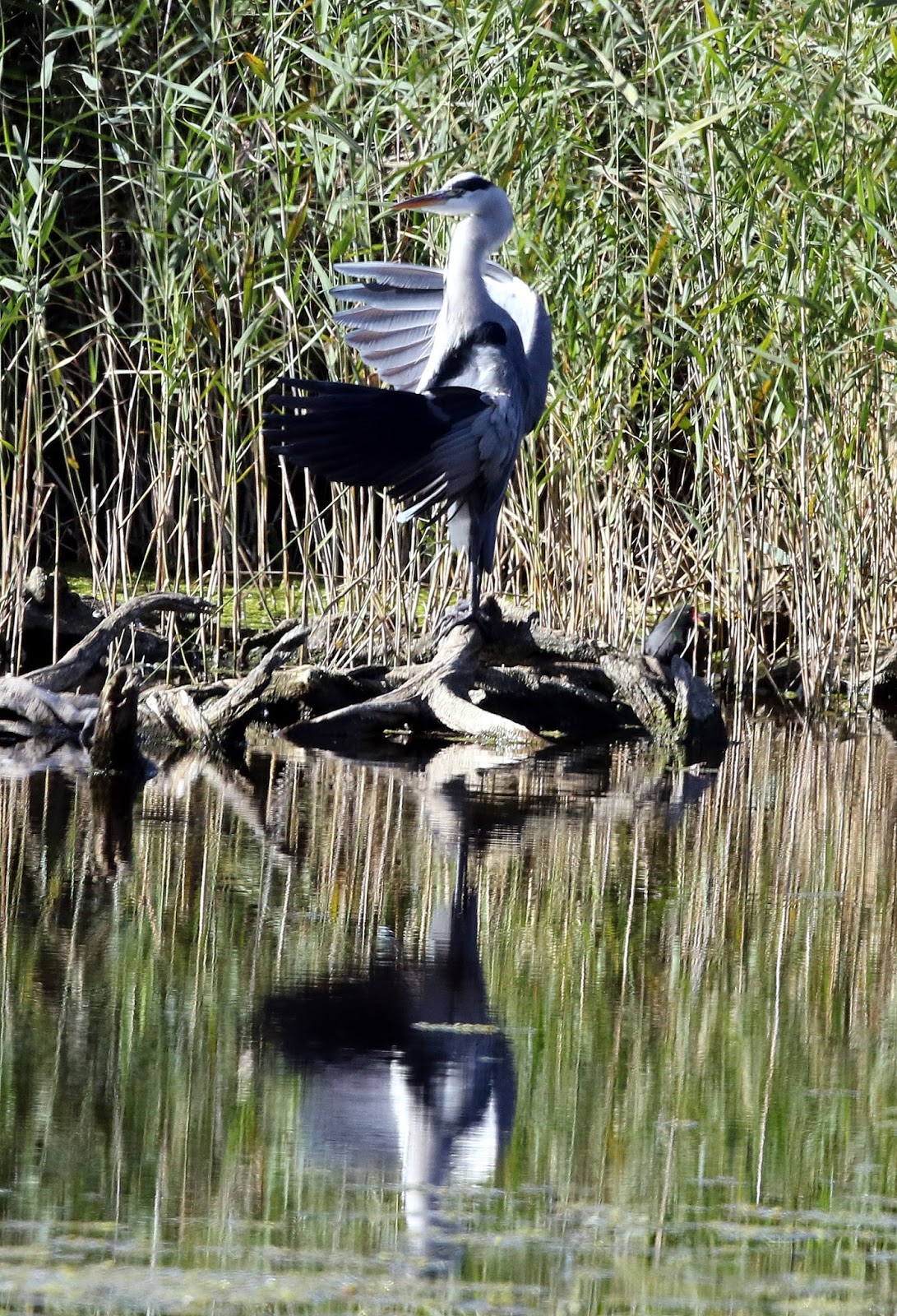
I knew it was there, stealthily stalking amongst the dense stand of reeds. I knew it was there because I'd seen it fly across the broad and land amongst the uniform stand of luxuriant summer growth. I knew it was there but I could not see its cryptically patterned form. Patience: the key to success, it was bound to show eventually. Other birds briefly enlivened the scene; jays looping to and fro in their mission to stash acorns, a green woodpecker bounding, a marsh harrier soaring, a Cetti's warbler blasting. But still the bird remained hidden. In the soporific warmth of another sultry early autumn afternoon, a brimstone butterfly, soon to hibernate in the shelter of some ivy clump, flittered lazily around the screen behind which I was positioned. Siskins, newly arrived from the dense tracts of Scandinavian forests, wheezed in alders above me whilst a heron stretched skyward spreading its voluminous wings to soak up the rays of the most welcome sunshine, looking for all the world like some sentry stood to attention. People came and went, chatting and picnicking and still the bittern cloaked itself in the matted undergrowth. Once a movement, slight but furtive, as the bird slowly emerged from the reed screen. I watched it briefly creep amongst the shallows poking around for fish fry or hapless amphibians; tantalisingly close but frustratingly obscured by dying reeds. And before long it slinked back into cover and disappeared.
 

Heron in Heraldic Pose


I started my Yare Valley excursion at Cantley Beet Factory, where I searched forlornly for a white-winged tern that had recently been dancing over the cloying waters of the settling ponds. Although there was no sign of this wanderer, the scene was enlivened by the tinny calls of bearded tits moving on short whirring wings through the abundant and luxuriant reed growth. I slowly tracked a small party and with the cover of a conveniently positioned hawthorn managed to position myself quite close to where these birds were feeding. What a delight to watch pristine males, fiery colours ablaze, cloaked in autumn shades of russet and gold that glowed in the glare of bright sunshine. They knew I was there, but determining I was no immediate threat, went about dismantling the dancing seed heads with gusto.    


Male Bearded Tit (with dark eye)


Male Bearded Tit (yellow eye)


Female Bearded Tit


Long-tailed Tit


Lapwings and a Ruff


These birds were numerous at Cantley

And then buzzards, a pair, mewing in the blue heavens. And then two more, and yet more until eight of these large raptors were spiralling above me on broad, fingered wings. Maybe these were local family groups or maybe genuine migrants moving lazily south as the season dictates. Whatever, they are always a pleasure to watch. Earlier, I had been alerted to another buzzard by the noisy attention of a large group of corvids, giving chase and generally harassing the larger bird. Crows seem to have great fun making mischief with raptors and these black tormentors, rooks and jackdaws mainly, seemed intent on inflicting as much misery as possible. The buzzard didn't appear to be too distracted; it simply glided purposefully on its way to richer foraging grounds.


The Buzzard Mobbed by Unwelcome Acolytes


And so we return to the opening scene, to Strumpshaw Fen and my lengthening wait for the bittern

I kept thinking that I really should be going home. I needed to move, but with the optimism bred of other long vigils keep giving the bird another 5 minutes, and another, and another. In all it took 2 hours of sitting quietly, waiting with finger poised on my camera shutter release, before I could briefly admire the spangled, marbled golds of its plumage at close quarters. It was no real trial, I chatted pleasantly to like-minded appreciators of all things wild, I could tune in to the merry chatter of the volunteer staff in the Visitor Centre, I basked in the warmth of the afternoon sun; no, it was no trial at all. Once the bird eventually broke cover, gliding from one reed fringed side of the open water to the other, I reeled off as many shots as my camera would allow. Through the telephoto lens I could note the intricacy of its camouflage, the stern looking countenance and the huge claws on its gangly feet. What a privilege. And then having been able to capture something of this beautiful, shy and mysterious bird, I myself slide off the bench, stretched my aching limbs to saunter back to my car, content and satisfied with the day.

Bittern


Thursday, 8 October 2015

A Week in Autumn


Autumn, the season of change: summers end and the gradual descent into winters frosty grip; chilly, mist enshrouded mornings and foreshortened evenings, soon to be gaining daylight at breakfast and robbed of an hour at day's end. The season of colour: rainbow hued woodlands, hedgerows ablaze with scarlet berries. The season when the natural world is in a state of flux: frantic activity of mammals to store provender for the long, cold months just over the horizon; the last flurry of butterflies and wasps feeding greedily on ivy flowers; the movement of birds in numbers beyond count from north to south around the world. And it is these things that I have witnessed over the past little while. 
 

Red Admiral on Ivy

 
Saturday 26th September - a brief trip to NWT Ranworth. A spell here, sitting nibbling a snack on the picnic area outside the visitor centre, was quite productive with a pair of hobbies and a pair of sparrowhawks spiralling above us in the clear skies of early autumn. The hobbies were intent only on catching winged insects on which to snack. The sparrowhawks, presumably a pair, were more intent on sparring, periodically stooping at each other and soaring together in tight circles.


Female Sparrowhawk


Sparrowhawk Pair

Note the size differential with the female being much larger than the male


Here we watched a tight group of cormorants herding fish around the shallow areas of the broad, whilst a dozen of their fellows watched on from the safety of the tern rafts. When I worked here I used to watch fascinated at the coordinated way in which these oily birds hunted. Sometimes there were 30 or more moving around the perimeter of the broad in a tightly packed group. They would push the fish before them and then plunge en masse into the frightened shoal. The group would proceed in like fashion for 30 minutes or so before breaking up and flying to the trees on the far bank to digest their catch. Although the waters of the broad suffer greatly from eutrophication, it is nonetheless used extensively as a breeding ground for bream, perch and various other species and a subsequent nursery ground for thousands of fry; rich pickings for hungry cormorants, grebes, terns and the occasional osprey.

Great Crested Grebe with Perch


Tuesday 29th September - a walk along the dune system at Horsey. The high pressure system dominating the UK over the past week or so has resulted in a strong easterly airflow. This should have brought in lots of migrants that making their way south, get caught up in the stiff airflow and make landfall at the first opportunity after traversing the North Sea. When you weight but a few grams it is easy to get displaced. The birding grapevine has been awash with reports of yellow browned warblers spotted from seemingly every coastal back yard, with this promise in mind I spent the morning walking the dunes between Horsey and Winterton. I saw no minuscule yellow and green waifs or strays. Instead I had to content myself with excellent views of stonechats and a lone whinchat, whilst tinkling parties of goldfinches fed on the seed heads of marram grass.


Goldfinches


Stonechat with Juicy Caterpillar!


Lovely Whinchat


Stonechat


Stonechat Preening


Thursday 1st October Gt Yarmouth/Gorleston. A sedate walk around the cemetery produced no sign of migrant activity other than a brief call of a yellow browed warbler that frustratingly failed to show itself. I should explain that Gt Yarmouth Cemetery is a very good spot for migrant birds as well as having some very interesting plant life. Nothing more sinister enticed us amongst the crumbling tombs. Later at Gorleston, turnstones were feasting on the carcasses of small crabs discarded by fishermen.  


Turnstone


Other recent highlights from Strumpshaw Fen:
 

Fishing Heron 


Little Egret


Little Egret Fishing


Otter


Little Owl


Saturday, 26 September 2015

What Is This Life, If Full Of Care, We Have No Time To Stand And Stare


In the welcome warmth of late September sun I stood stock still, alone, for 90 minutes on a path dissecting the wet meadows at Strumpshaw Fen. I was waiting. Waiting for a hobby to come close enough for me to capture something of its swift scything flight through the lens of my camera. The bird, a juvenile, appeared every so often jinking this way and that in the clear blue heavens. It was hunting dragonflies that in this summer reprise abounded, themselves darting hither and thither in their frantic quest for a mate before the chill of early autumn once more held sway and cut short their already brief role on this wetland stage. The hobby knew I was there, how could it not? A bird that can espy flying insect prey from a range of over 100 metres and home in on it with all the precision of a feathered exocet is unlikely not to have registered my presence below. But I remained still and patient.

A jay flew by crop full of acorns with another clutched firmly between its strong black mandibles. Raiding an oak on the north side of the river it flew to the marshes bordering the southern bank to stow away the plunder in instinctive anticipation of harsh times ahead. Back and forth it flew a half dozen times whilst I stood there in my unobtrusive garb and I know it too was aware. Flocks of Canada geese barked their way low over my head and a mute swan raised itself tall, lazily flapping its wide white wings and vigorously waggling its rear end before commencing a leisurely cruise along the drain. A loose flock of martins and swallows, mere ghostly specks high in the azure vastness whirled slowly east. And still the hobby swooped over the tree tops tantalisingly out of range, its bright cheek patches catching the sun as it twisted with effortless agility to snatch another morsel from the air.


Jay

These colourful crows are very evident at this time of year as they
stockpile acorns ready for winter
 

Canada Geese


Presently a kestrel entered the scene causing the hobby to suspend its hunting to flirt with the interloper. The pair cavorted over the marsh for a couple of minutes but it was plain they were simply mock fighting; they were too evenly matched and with an abundance of food and no territorial imperative why would they need to risk injury? A buzzard floating across the stage was another matter and both the hobby and the kestrel joining forces took exception to this much larger hook-billed character. The smaller falcons took turns to stoop at the buzzard driving it back from whence it came before once more resuming their playful sparring. Eventually the kestrel tired of the sport and with a touch more intent lunged at the younger bird and sent it packing, arrowing away to hunting grounds anew. I waited on.


Hobby Mobbing the Buzzard

As the morning slid seamlessly into afternoon drifts of cloud began to roll in from the west and the breeze gained strength, threatening the promised rain showers. I was beginning to toy with the not unwelcome thought of smooth hot chocolate and a snack in the shelter of the reception hide when the hobby glided back to its favoured position low over the trees bordering the marsh. I willed it closer and as if responding to my thoughts it began to wheel towards where I stood. Swooping even closer and plunging low towards some unseen bounty it inadvertently trespassed on the kestrels patch which appearing from nowhere once again engaged. Both birds, intent now only on each other, flew directly across my path and I snapped away hoping that the camera would not render my long vigil fruitless. But it doesn't really matter. The exhilaration of having these fine birds momentarily oblivious of me and chasing each other a few feet above my head made all the waiting worthwhile,  belittling the need to worry over a digital image. The mental image I have now as I close my eyes to relive the moment is better by far. Sometimes it pays to simply stand and stare.  

The Kestrel


The Hobby....At Last!


Monday, 21 September 2015

Of Tigers, Elephants and Old Ladys


Moths are subjects that seem to invoke strong emotion. A friend of mine hates them with a vengeance, protesting her loathing of these demonic creatures of the night with a shudder. She refuses point blank to even take a tentative peep into a moth trap despite my reasoned arguments that they are harmless and really quite fascinating. 'I'd rather give myself an enema' she will say, or something to that effect (she is a nurse). I questioned her once as to why this should be and it seems that when she was a small child a moth flew into her room one night and with its manic fluttering traumatised her to such an extent that she exhibits this extreme aversion. She loves butterflies though.

Sadly this otherwise well balanced lady is not alone in exhibiting extreme prejudice against moths; it must be the association with the mysteries of the dark hours when all things evil stalk our suburbs. I've read more than one short horror story where a moth, usually of gigantic proportions, has been the focus of the tale. In fact as I recall they all seem to involve some poor schmuck being smothered in his bed by the crazed insect, so maybe my friend's childhood experience is attuned to this primitive fear. What total crap though, I mean honestly they're harmless nectar sucking insects for goodness sake. Get a grip I say. In any event moths really do seem to get a totally unjustified bad press. Thank goodness then that we're above all of this tomfoolery and are here to celebrate the diversity of the natural world.

A few years ago one of my morning shifts working in Reception at Strumpshaw Fen coincided with the assistant warden emptying his moth trap. Having never witnessed such an unveiling before, I sauntered over intrigued as to what would be revealed. Suffice to say I was so enthralled that I spent the next hour snapping away at the vast number of multi coloured and multi shaped insects that had been captured overnight. I had simply never appreciated the sheer numbers and variety of species that could be found in one area. So began my love affair with these largely nocturnal creatures, one that endures to this day. I built my own trap and for the past 8 years or so have regularly, harmlessly ensnared moths in my garden at Sprowston as well as sometimes helping with the monitoring of moths at Mousehold Heath and running moth events for Norfolk Wildlife Trust. It is an addictive hobby simply because you just never know what may turn up. On occasion Ive been so consumed with curiosity that I've been known to pay close scrutiny to the walls of concrete toilet blocks....but luckily got off with just a warning.

The Strumpshaw Moth Trap -My induction to an absorbing pastime 


Garden Tiger - One of the moths that entranced me

 
I tend to leave my trap on overnight, which does necessitate some very early awakenings during summer to close it down and move it to a safe place before the local blackbirds and robins discover a free breakfast. However, the excitement of having a good relaxed rummage through the empty egg cartons later in the day with a nice cup of tea within easy grasp, is ample compensation for an interrupted slumber; the sight of a dozen large and hulking hawk moths never fails to impress. And it is truly a year round hobby; in fact several species only emerge during the colder nights of autumn and winter. Some Continental migrants, which include real beasts like the convolvulus and deaths head hawk moths, will be arriving now and through October if were lucky.

I was once asked at a public event by a grown man that should have known better why anyone should care about moths, his tone implying that surely it wouldn't matter if they didn't exist. The question momentarily dumbfounded me, not for its banality - we should surely all care about all forms of wildlife - but more for the fact I hadn't thought about their role in the natural world to any depth. Of course the answer is that they form a crucial link in the food chain and are an important source of sustenance for bats and birds; many are pollinators of plants taking over from day flying bees and butterflies; the larvae also form hosts for parasitic wasps. Additionally, moth larvae are a prime component of the diet of nestling passerines whose parents time their breeding cycle to coincide with maximum availability of these little wrigglers; take moths out of the equation and your local blue tits would disappear pretty sharpish.

Hornet Moth

An amazing example of mimicry. This species looks very like a
hornet thus ensuring predators give it a wide berth. The small
eyes, long antennae and mottled wings give it away. 

Buff Tip

An example of cryptic camouflage - the front end looks uncannily like the
broken end of a birch twig. 

Buff Tip Caterpillars at Whitlingham Recently


Leopard Moth

Another strategy to avoid predation is to play dead. This one rolled up and
collapsed in a heap when I touched it.

To cap it all they are beautiful in their own right and have such quirky names. Setaceous Hebrew  Character springs to mind as a fine example of a Victorian academics attempt to bamboozle us lesser mortals, whilst finding favour with muckers in his club. But there are others. We have the Ni Moth (the nights of Ni?) for example, then Uncertain, Anomalous and Suspected which conjures images of bespectacled gentlemen curates scratching their heads and wondering what the hell they had discovered. Merville du Jour adds a Continental flavouring and then my favourite, the Large Ranunculus, which Im sure was a condition my grandfather had. Aren't they great? Certainly a bit more arresting than their butterfly cousins: large white, small white, common blue etc. Still, I guess with nearly 900 macro moths and many more micro moths to be found in the UK our predecessors ran out of simple names and had to resort to something more flowery. In fact the common English names of many moths refer rather to their larval form rather than the adult insect. The elephant hawk moth is a good example of this anomaly whereby the finished article of largely pink and green looks as much like an elephant as does a giraffe. Stumble upon one of the wrinkled and tapering caterpillars however and you will immediately see the resemblance to an elephant's trunk. I discovered one of these quite large caterpillars shuffling across the boardwalk at Ranworth one late summer day whilst I was managing the Visitor Centre there. Rather than leave it for someone to squash, I temporarily put it on public display. For the rest of the afternoon this digestive tube entertained numerous kids and adults who had probably never seen such a thing before. Nothing like a bit of real live nature to get people hooked.


Setaceous Hebrew Character

Can you see why it is so called? Nope neither can I.
 

Merville du Jour

A prized autumn speciality
 

Large Ranunculus


Other hawk moth larvae were frequently the subject of great concern to members of the public who found them garishly occupying their favoured spot on the patio. Us folk manning the NWT Wildline regularly administered consoling words, reassuring the trembling caller that the fearsome looking protuberance was not a sting and to stand down the emergency services. To their great credit these callers were actually simply astonished to see something so alien in their environs and wanted to know what on earth it was. Perhaps a stark reminder of how scarce these things have become nowadays and/or how detached people are from the natural world around them. In any event it goes to illustrate another surprisingly attractive element of the overall lifecycle of moths.
 
When you consider the UK has only about 60 resident butterflies, the appeal of moths can begin to be understood. There is simply a heck of a lot more to find. Here in Norfolk something like 670 macro and over 1100 micro moths have been found and the list is being added to all the time thanks to the efforts of amateur recorders trapping in their gardens and submitting records. My own modest garden list boasts about 250 macros and there are also some micros, but truth be told their identification is a time consuming occupation and most only have Latin names which makes me go cross-eyed. If I can discover 250 moth species in my garden then so can you, and the thing is you dont even know they are there until you look.

All of this has made me look at moths in a totally different light and has truly opened up a whole new world of exploration. You dont even need a moth trap and you dont even need to wait until dark. Many moths fly during the day and many happily flock to a simple lure comprising a length of thin rope soaked liberally in red wine and sugar draped across your shrubbery (who wouldnt). Alternatively, you can simply go out into your garden at night with a torch and have a look around the flower heads of buddleia, or on fallen fruit which is irresistible to some species.

Old Lady

These large and impressive moths are easily lured to wine ropes. 

Herald

This one was attracted to a thick mixture of molasses, dark sugar and a dash
of rum liberally painted on the garden fence. Just remember not to lean against
it the next day.

Sugar Feast!

Various moths tucking into the gunk mentioned above

Large Yellow Underwing

These moths and many others are attracted to buddleia at night in much the same
way as butterflies are during the day.

Six-spot Burnets

Day flying moths that can be very numerous
 

Red Underwing


What a beauty - flushed from riverside vegetation at Cantley last week
 
If you get a chance I would get yourself along to a moth trapping event next summer, you will be genuinely surprised and fascinated by what you find. Have a look at the NWT website to keep abreast of events they run. And because they are simply stunning a few more hawk moth pics....
 

Lime Hawk Moth


Poplar Hawk Moth


Privet Hawk Moth